
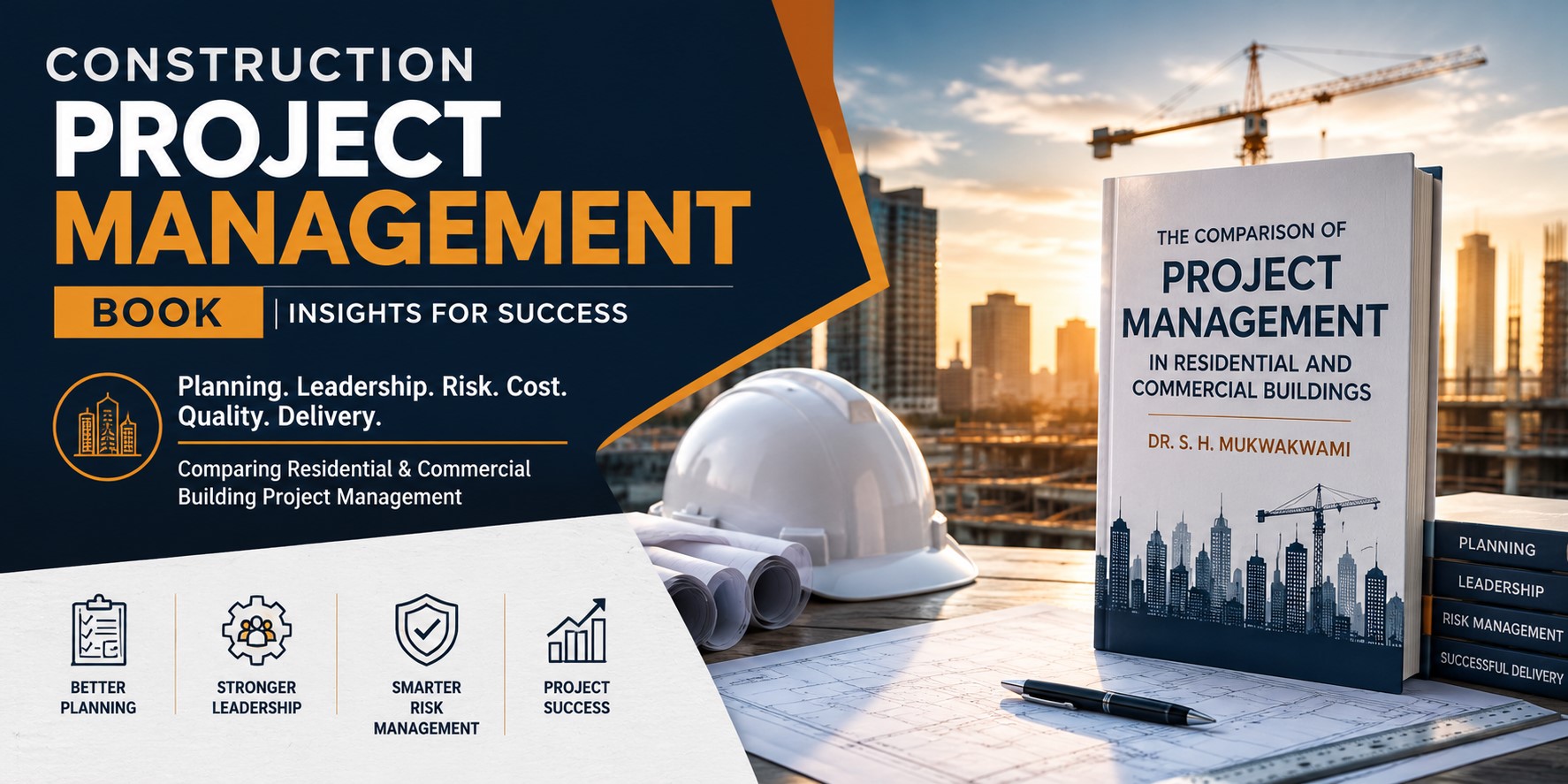
Do you know why construction project management matters? Construction project management is an invaluable skill. Managing complex data with interconnected tasks and teams justifies project management, as does creating a schedule and setting objectives, maintaining commitments, empowering individuals, and avoiding the pitfalls inherent in all projects. The project manager must also pay attention to budget forecasting, finances, organization, scheduling, conflict resolution, and legal issues. In this constantly evolving sector, a construction project manager must possess the skills and capabilities required to manage all of these aspects, as well as multiple projects and their supporting teams simultaneously. Let’s quickly explore this construction project management book below.
Book Review: Dr. S. H. Mukwakwami’s Approach
“The Comparison Of Project Management In Residential And Commercial Buildings” by Dr. S H Mukwakwami is one of the leading construction management books where Mukwakwami compares the differences in project management in both residential and commercial buildings. The writer discusses leadership style, risk management, working methods, ethics, and sustainability in both areas. The difference is that commercial projects, which have PRINCE2-certified experts, require a more formal framework and certification like CSCS (Construction Skills Certification Scheme).
Starting with Project Identification
It is crucial for the engineer managing a project to understand all the challenges the team will face fully fully. Therefore, rigorous project identification is essential. While the method presented here is not the only one developed by academic and business communities, it remains a good example to follow so that the project engineer can better grasp the issues and opportunities the project offers their team.
To this end, the various proposed analyses must be carried out and recorded in a document, the Project Implementation Plan (PIP) in this case, which will be submitted to the client for approval. Whenever possible, the engineer should conduct such analyses, if only to better understand the various issues and the complexity of the project for which they are responsible.
Defining the Project: What Exactly Is It?
Many have attempted to define the concept of a project; here are two examples.
- A project as “a unique process of transforming resources to achieve a specific output at a specific time, within budgetary, material, human, and time constraints.”
- A project as “a temporary undertaking undertaken for the purpose of creating a unique product, service, or outcome.”
Such definitions contain certain characteristics that must be considered when identifying or defining a project. These characteristics are:
- novelty and uniqueness (a unique process or outcome);
- a limited duration (on a one-time basis);
- the presence of a client for whom the project must be carried out;
- subjection to strong performance, time, quality, and cost constraints (budgetary, material, human, and time constraints). Furthermore, a project is subject to several factors:
- a dynamic life cycle;
- the involvement of numerous participants, representing diverse interests, organizations, disciplines, and cultures;
- a context of uncertainty regarding the environment, technology, and resources;
A project generally involves doing something new, something that hasn’t been done before in exactly the same way or in the same context. The degree of novelty or uniqueness can vary considerably from one project to another. The limited duration characteristic in a project is inherently temporary, subject to a predetermined start and end date.
The duration of a project can be relatively short, a few weeks, or very long, several years in the case of a megaproject.
The Role of the Client in Every Construction Management Project
Indeed, the objective of a project must always be to satisfy the needs of a given entity (e.g., internal client, individual, company, organization, government). This client must be consulted to define their needs and establish an appropriate action plan clearly.
Client satisfaction presupposes that the project has been carried out in accordance with their requirements.
These requirements are generally formulated based on four types of constraints:
- performance standards related to the operation of the product or service;
- quality standards for the product or service;
- delivery deadlines;
- the cost of the project;
- The relative priority of these four types of constraints varies considerably from one project to another depending on various imperatives.
Introduction to Construction Project Management

Technically, project management is “the art of directing and coordinating human and material resources throughout the life of a project using management methods to achieve objectives in terms of cost, time, quality, and participation.” When defining construction project management, this essentially corresponds to the context of the building industry.
This encompasses everything related to planning, coordination, processes, and controls, among the countless tasks involved in a construction project. It applies to all types of projects – residential, commercial, institutional, industrial, civil, agricultural, or environmental.
Managing a construction project is not something that can be improvised, as it requires the ability to handle tasks that will always differ from one project to another. A construction project manager must possess strong communication skills and be well-informed about construction processes and problem-solving.
Meet the Construction Project Manager: Key Responsibilities Unveiled
Construction project managers ensure that a project adheres to the established plans. They monitor that projects are completed on time, that budgets are met, and that all building specifications and regulations are met.
Construction management certification bodies have identified specific responsibilities for the construction manager and categorized them into different areas:
- Project Management Planning
- Cost Management
- Time Management
- Quality Management
- Contract Administration
- Safety Management
- Construction Management Practices
Following the completion of the phases, a tendering process is initiated, allowing the project manager to award the contract to specific contractors. The selection process typically involves three methods: a limited number of bids, the best value for money, or a skills-based selection. Contractors are responsible for decision-making, managing mathematical calculations, drafting, human resources, public safety, time and cost management, and quality control.
Why Construction Project Management Is the Key to Project Success
Construction project management has a decisive impact on the success of construction projects. It ensures effective coordination of all project stages and plays a central role in successfully completing complex projects on time and within budget. A key aspect of construction project management is optimizing communication among all stakeholders.
Key success factors in construction project management include:
- Clear communication: GDPR-compliant communication enables secure information exchange.
- Up-to-date documentation: Providing current documents and plans for all projects and participants is essential.
- Ease of use: Construction project management should be implementable without extensive training.
- Automation: The creation of build reports, delay notifications, and other important protocols should be automated.
How to Measure Project Success in Construction
To measure the success of a project, the following aspects must be considered:
- Adherence to deadlines and budget
- Quality of work performed.
- Satisfaction of all project stakeholders
- Efficiency of workflows
Good construction project management allows for continuous monitoring of these factors and rapid intervention when necessary.
Mukwakwami’s Construction Project Management Book: A Chapter-by-Chapter Breakdown
“The Comparison Of Project Management In Residential And Commercial Buildings” summarizes the key aspects of project planning and management. It is developed in the following chapters: introduction to project management, project management and planning, structuring into work packages, time management, schedule development, resource planning, project cost management, project risk management, project monitoring and control, project change management, project manager skills, project closure, and lessons learned from the project.
Overall, the construction project management book provides an in-depth comparison of methodologies, highlighting both the differences and similarities between residential and commercial building projects, and emphasizes the importance of structure, certification, and ethical practices in successful project delivery.